
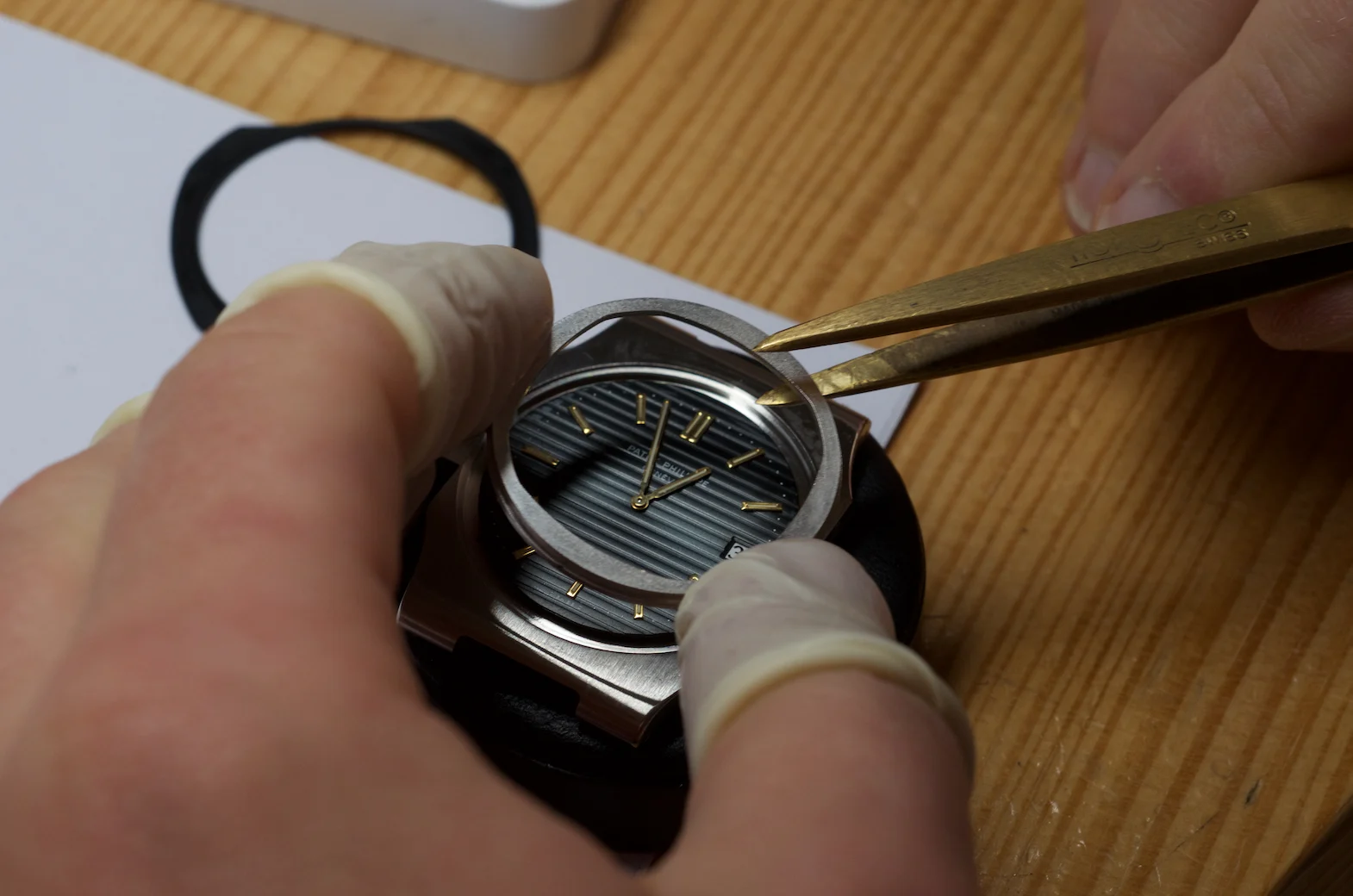
A faint mist under the crystal that clears within a few minutes is usually nothing to worry about. Mist that stays, or any droplets of water, means moisture is inside the case, and the watch needs a watchmaker soon. This guide comes from our Melbourne watch repair workshop. It explains how to tell the two apart and what to do straight away.
Fog that clears, and fog that doesn’t
The air sealed inside a watch case holds a little moisture. When the watch is suddenly chilled, that moisture can settle on the underside of the crystal as a light fog.
The Japan Clock & Watch Association gives two common examples: cold air from an air conditioner on a summer’s day, and stepping out of a warm room into the cold in winter. If the haze does not disappear for a long time, it says, moisture may have got in and you should stop using the watch.[1] Citizen likewise says to have a watch inspected if fog does not clear even after a long time.[2]
As a rough guide:
- A light mist after a sudden temperature change that soon clears. Usually harmless. If it starts happening more often, have the seals checked.
- Mist that lingers, or returns without a change in temperature. Moisture has probably got past a seal.
- Droplets, a wet look under the crystal, or new marks on the dial. Water is inside. Act now.
Why Melbourne’s changeable weather can fog a watch
Melbourne’s weather is known for changing quickly, and that is exactly the kind of swing that fogs a crystal. Walking off a warm, humid street into a cold, air-conditioned office will do it. So will leaving a heated house on a cold winter morning. Healthy seals take this in their stride. Tired seals let a little more humid air in each time, so fog that appears more often than it used to is worth noticing.
Summer brings its own risk. After a swim at the bay or the beach, rinse the watch in fresh water, as Seiko, Citizen and Omega all advise, then dry it with a soft cloth.[2][3][4] If seawater has got inside the case, Citizen says to take the watch in for repair immediately.[2]
What to do straight away
- Take it off. Don’t keep wearing a watch with moisture inside, even if it is still running.[5]
- Leave the crown and pushers alone. Citizen and the Japan Clock & Watch Association both warn that operating the crown or buttons while moisture is present can let more water in.[2][5] Don’t pull it out to set the time.
- Check the crown is pushed fully home. If it screws down, make sure it is screwed in, as Citizen and Omega advise.[2][4] Don’t force it.
- Don’t heat it. A hairdryer, heater or sunny windowsill can damage the seals, the oils and the dial, and it won’t draw water out of a closed case.
- Don’t open it yourself. Without the right tools you risk scratching the caseback, damaging the seals and letting in dust.
- Bring it to a watchmaker promptly. The sooner it is opened and dried, the less there usually is to put right.
Why speed matters
The Japan Clock & Watch Association says water inside a watch damages the internal mechanism, the precision electronic components and the dial, and that the watch should be repaired immediately.[5] In a mechanical watch, the steel parts can begin to rust, and rust spreads the longer it sits. In a quartz watch, the circuit and battery are at risk as well. Moisture can also spot a dial or mark the hands, and that kind of damage cannot always be fully undone.
What a water resistance rating does and doesn’t mean
The rating on the dial or caseback describes how a watch can be used. It is not a depth you can dive to. Seiko’s table rates a 3 bar watch for accidental splashes and rain only, a 5 bar watch for swimming and showering, and a 10 bar watch for bathing and shallow diving as well.[3] Citizen sets similar limits: 3 atmospheres means occasional accidental splashes, and 5 atmospheres means swimming but not skin diving.[2]
A rating is also not permanent. Seiko says water resistance does not last indefinitely, because gaskets age and an accidental knock can distort parts.[3] Omega notes that its gaskets deteriorate over time, partly from temperature changes, and must be replaced regularly.[4] The Japan Clock & Watch Association adds that perspiration and moisture make gaskets brittle over time.[5]
So a watch that hasn’t been serviced for years, or a vintage piece, may no longer resist water the way its dial says it should. Our guide to when a watch needs a service covers the signs to look for.
Having a wet or fogged watch checked in Melbourne
Our workshop is in the Melbourne CBD, at Level 1, 20-22 McKillop St, and we have been Melbourne based since 2011. Visits are on weekdays, by prior appointment. Get in touch through our contact page and mention there is moisture inside.
A wet watch is assessed first. It is opened, inspected and explained, and you hear what it needs and your options before any work is agreed. Nothing goes ahead without your say-so.
No one can say what a wet watch needs until it is open. Sometimes the damage is slight. Sometimes parts have to be replaced, and marks on a dial may not come out completely.
If the movement needs a service, the work is done in-house: strip down, clean, lubricate and regulate, with parts replaced only where needed. For what a full service involves, see our article on Rolex service costs in Australia. Case and bracelet refinishing happens on the same premises, as our restoration page shows. If it has already stopped, our guide My watch has stopped. Is it worth repairing? helps you decide.
You don’t need to have bought the watch from us. Bring us any fine Swiss watch and we will take the time to explain what it needs.
Sources
- Japan Clock & Watch Association: the inside of glass is clouded. Why?
- Citizen instruction manual, mechanical calibre 9183 (water resistance and precautions)
- Seiko Australia: water resistance
- Omega Australia: using your Omega watch
- Japan Clock & Watch Association: how should I care for my water-resistant watch?