
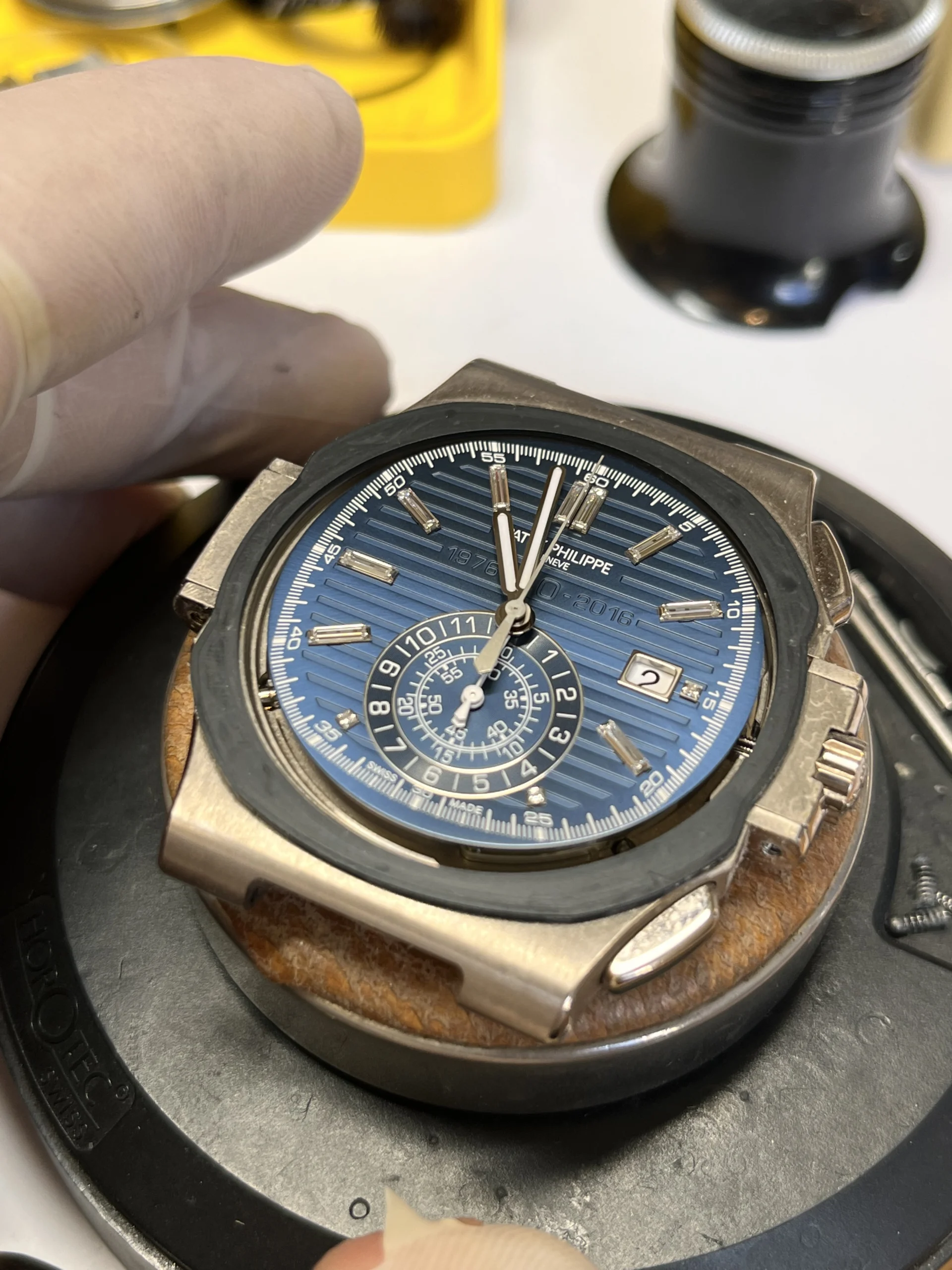
Usually, yes. A stopped mechanical watch is rarely beyond repair, and many stop for simple reasons. This guide comes from our watch repair workshop in the Melbourne CBD, where stopped watches are assessed on the bench. Whether a repair is worth it depends on why the watch stopped, what the work involves and what the watch is worth to you. You won’t know the first two until a watchmaker has opened it, so start with the checks you can do at home.
First, rule out the simple causes
An automatic that hasn’t been worn. An automatic watch winds itself from the movement of your wrist and stores that energy in its mainspring. Take it off and it runs until the stored energy is used up, then stops. Seiko, for example, says its 4R calibre runs for about 41 hours once fully wound.[1] Other movements run longer or shorter, so check the specification for your calibre. A watch that sat in a drawer for a week has almost certainly just run down.
A manual-wind watch that needs winding. A hand-wound watch has no rotor. If it isn’t wound, it stops.
To restart either, turn the crown slowly clockwise with it pushed in (unscrew it first if it screws down). Seiko notes that a fully stopped watch won’t start straight away, because the mainspring gives little force at the start of winding. Keep winding and the seconds hand will start once it has enough.[1] Set the time, wear it for a day and see whether it keeps going.
A quartz watch with a flat battery. If a quartz watch stops, the battery is the first suspect. Seiko advises replacing a battery soon after it runs out, to avoid damage from leakage.[2] A battery left in a stopped watch for years can corrode the movement, so don’t leave it.
If the watch runs normally after winding or a new battery, it may need nothing more. If it stops again within a day, or never starts, there is a fault inside.
When it’s more than winding
These signs point to a problem a watchmaker needs to see:
- It stopped after a knock or a drop. A hard impact can damage the small parts that regulate the watch.
- It runs, but gains or loses a lot of time. Magnetism is a common cause. Seiko explains that a magnetised hairspring makes the balance swing unevenly, so the watch gains or loses time, and that the fix is to have it demagnetised.[3] Phone speakers, laptop and tablet covers and magnetic clasps are everyday sources.
- There’s fog or water under the crystal. Stop wearing it and have it checked promptly. Moisture inside causes rust, and the damage grows the longer it stays there. Our guide to water or fog inside a watch explains what to do first.
- The crown feels gritty, loose or won’t wind. The winding parts or the crown and its seals may be worn or damaged.
- It hasn’t been serviced in many years. The oils in a movement age, and worn parts that run without them wear faster. Our guide to when a watch needs a service covers the signs in more detail.
What not to do
- Don’t open the caseback yourself. It risks scratching the case, damaging the seals and letting in dust.
- Don’t keep shaking or forcing it. If winding doesn’t start it, more force won’t help.
- Don’t keep wearing a watch with moisture inside, even if it’s still running.
How to decide whether it’s worth repairing
Once the watch has been assessed, you can weigh a known cost against a few questions.
What is the watch worth in good working order? A fine Swiss watch from a respected maker often holds value well. If it would be worth clearly more serviced than the repair costs, the decision is easy. Our article on Rolex service costs in Australia gives an idea of what a full service involves.
What does it mean to you? Many stopped watches are inherited. If it was your father’s or grandfather’s, the value to you may have nothing to do with the market, and that is a perfectly good reason to repair it.
Can it be repaired properly? For older and vintage watches, the right parts may be scarce, and sourcing them can take time. A good watchmaker will tell you honestly if a part is hard to find, and what that means for the work.
Would you rather sell it? If you don’t want to put money into it, selling may suit you better than a repair. A stopped watch from a respected maker can still have value. Our page on selling a watch explains how we assess one.
Having a stopped watch assessed in Melbourne
Our workshop is on McKillop Street in the Melbourne CBD, and we have been based in Melbourne since 2011. Visits are by appointment on weekdays, so there is time to look at your watch properly. A stopped watch is assessed before anything else. The watch is opened, inspected and explained, and you hear what it needs and your options before any work is agreed. Nothing goes ahead without your say-so.
If you go ahead, the movement work is done in-house: strip down, clean, lubricate and regulate, with parts replaced only where needed. Timing, amplitude and power reserve are checked before the watch leaves the bench. If the case or bracelet is tired too, refinishing happens on the same premises. You can see examples on our restoration page, and our guide to refinishing a scratched case or bracelet helps you decide whether to.
How long it takes depends entirely on the watch. Some need a straightforward service. Others need parts that have to be found first.
You don’t need to have bought the watch from us. Bring us any fine Swiss watch and we will take the time to explain what it needs.