
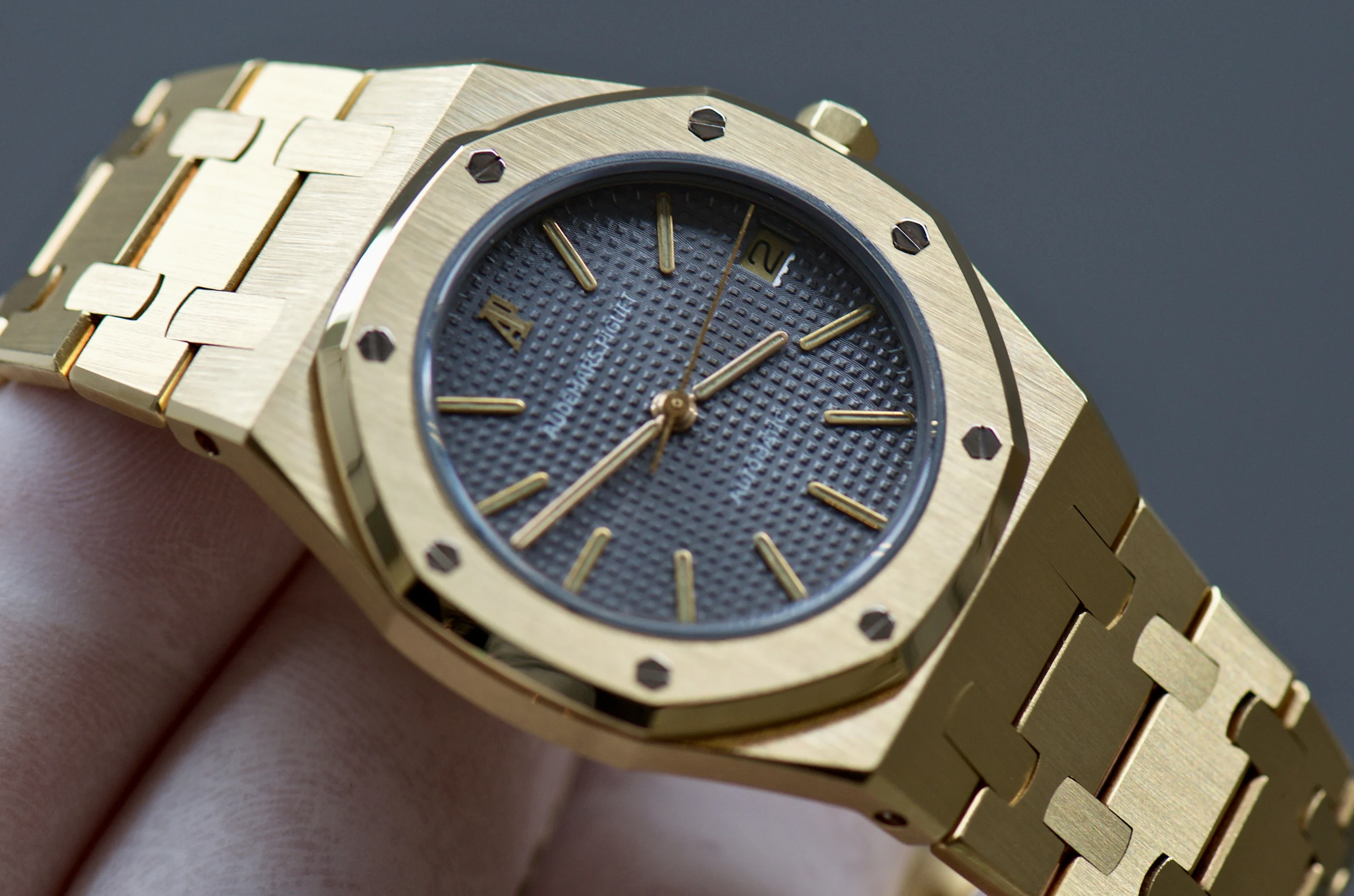
It depends more on the watch than on the scratches. A modern steel watch you wear every day can usually be refinished well. An older watch with sharp, untouched lugs may be worth more left as it is. This guide comes from our Melbourne workshop, where case and bracelet refinishing is done in-house alongside servicing. It is written for owners. If you are buying, our guide to polished vs unpolished Rolex watches covers what to ask a seller.
What refinishing actually does
Polishing removes metal. Each time a case or bracelet is polished, a thin layer comes off. TAG Heuer advises polishing sparingly for this reason, noting that over time it can subtly alter the shape of the case or bracelet.[1]
Most fine watches combine two finishes. Brushed, or satin, surfaces carry fine parallel lines. Polished surfaces are mirror bright. Good refinishing returns each surface to its original finish rather than buffing everything to a shine. Seiko describes this in its King Seiko service: a mirror finish where the case should have one, fine hairline finishing where appropriate, and hairline finishing applied by hand to each bracelet link.[2]
The edges matter most. Where a polished bevel meets a brushed flank, or a chamfer runs down the lug, a crisp line is what makes a case look right. A soft polishing wheel rounds those lines off, and the metal that formed them is gone. Longines says that when it restores an older watch, the case is polished to the original specifications, taking its age into consideration.[3] That is the right standard: the original lines, not a new shine.
A light refresh or a full refinish
A light refresh brings brushed surfaces back to an even grain and lifts the fine scuffs of daily wear, especially on the clasp. It takes off very little metal, and for many everyday watches it is enough.
A full refinish works out deeper scratches and dings, redefines edges and bevels, and restores polished and brushed areas separately. It removes more material, so it is worth doing when the wear genuinely bothers you or the case has already lost its shape. Seiko notes that some deeper scratches may not be completely removed,[2] and chasing them all can take more metal than the case can spare.
When leaving it is the better choice
Collectors value unpolished vintage cases because factory edges can’t be put back once they have been polished away. Scratches show a watch has been worn. A softened case shows it has been polished, and many collectors would rather have the first.
Leave it, or ask for advice first, if:
- The watch is vintage and the case looks untouched. Sharp lugs and crisp bevels on an older watch are worth protecting.
- The lugs are already thin. A case polished several times before has less metal left to give.
- There are hallmarks or engravings. Polishing near them can soften or erase them.
- The case is solid gold. Gold is soft, so it marks again quickly, and every refinish takes precious metal with it.
- The case is plated or coated. Polish through a plating and the base metal shows, and polishing can’t bring it back. Grand Seiko notes that light polishing may not be possible on plated or treated surfaces,[4] and Breitling excludes watches with a black DLC coating from polishing.[5]
Bracelet stretch is a different problem
A bracelet that hangs loose or sags is usually worn at the pins and links, where they rub against each other. Polishing the outside won’t fix that. A bracelet can be refinished to look excellent and still be stretched, so if both bother you, mention both.
Scratches on the crystal
The glass is a separate fix. Acrylic crystals, common on older watches, are soft, and light scratches can often be polished out. Sapphire, used on most modern fine watches, resists scratching, but a scratch you can see in sapphire usually means a new crystal.
Refinishing with a service, in the same Melbourne workshop
Refinishing properly means taking the watch apart, so the movement, crystal and seals are out of harm’s way. Since the case is apart for a service anyway, that is the sensible time to refinish it. TAG Heuer says polishing is typically done during a complete maintenance service.[1]
At our Melbourne workshop, servicing and refinishing are both done in-house on the same premises, so the watch isn’t sent elsewhere between the two. If yours is due for a service, our guide to when a watch needs a service covers the signs. If it has stopped altogether, see whether a stopped watch is worth repairing.
How to decide
Wear it as it is. Fine scratches on a daily watch come back quickly. If they don’t bother you, leave it.
A light refresh. For a modern watch with scuffed brushing or a tired clasp.
A full refinish. For a case with real dings, or one badly polished in the past. Best done with a service.
Leave it for value. For a vintage watch with an untouched case, engravings, thin lugs or plating. If you are thinking of selling, ask before refinishing anything. Our page on selling a watch explains how we assess one.
Having a case or bracelet refinished in Melbourne
Our premises are at Level 1, 20-22 McKillop Street in the Melbourne CBD, and visits are on weekdays by prior appointment. Bring the watch in so we can look at the case under the light. It is examined and documented before any work is quoted, and we explain what refinishing would change and whether it is worth doing at all. Sometimes the honest answer is to leave it alone. Nothing goes ahead without your sign-off on the work and the cost.
If you go ahead, the refinishing is done in-house with specialist equipment that keeps the factory edges, chamfers and graining. You can see examples on our restoration page.
We have been Melbourne based since 2011, and you don’t need to have bought the watch from us. Bring us any fine Swiss watch, or contact us to arrange a time.